



Advertisement
Advertisement
Israel's initiative to establish a so-called "humanitarian city" on the remnants of Rafah in southern Gaza has faced harsh criticism from two former Israeli Prime Ministers. They argue that this plan could confine Palestinians in what is essentially "a concentration camp" and potentially lead to ethnic cleansing amidst the ongoing conflict in Gaza.
What is Israel’s “Humanitarian City” plan?
Defence Minister Israel Katz has put forward a proposal to construct a new settlement to accommodate hundreds of thousands of Palestinians displaced by Israeli military actions. The plan aims to initially settle around 600,000 individuals and eventually relocate Gaza’s entire population of over two million into this single area. Katz has stated that Palestinians would not be permitted to exit the city except for international travel.
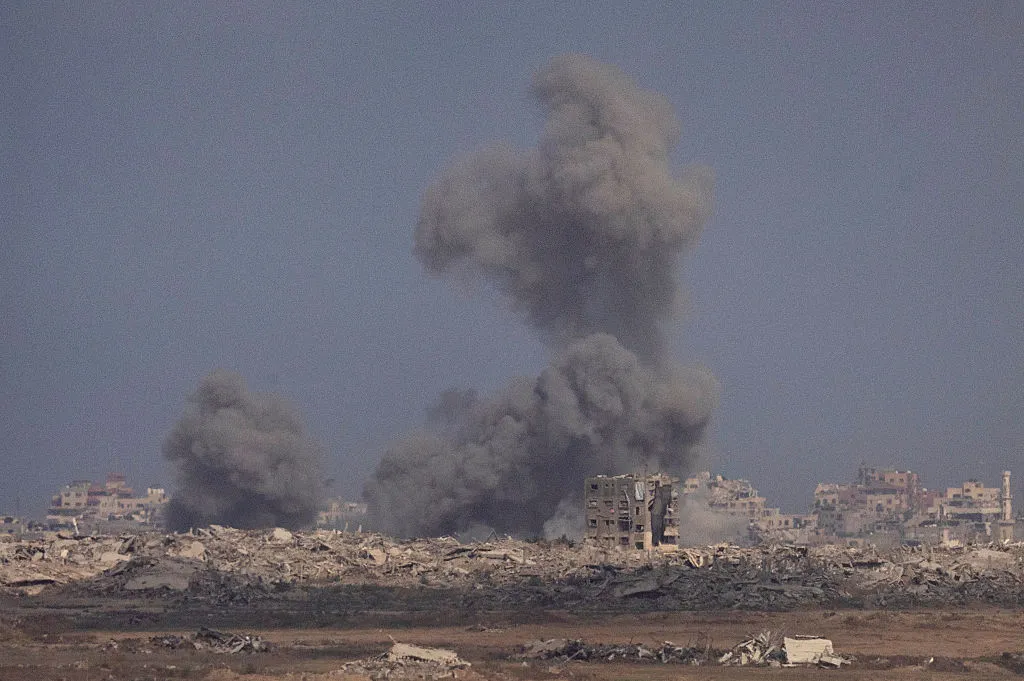
Gaza on July 13, 2025. (Photo by Amir Levy/Getty Images)
Former Israeli Prime Ministers condemn “Humanitarian City” plan
Ehud Olmert, who served as Israel's leader from 2006 to 2009, was unequivocal in his disapproval. Speaking to The Guardian, he remarked: “It is a concentration camp. I am sorry.”
Olmert cautioned that forcing Palestinians into the “humanitarian city” could be seen as ethnic cleansing.
“If they [Palestinians] are deported into the new ‘humanitarian city’, then this can be considered part of an ethnic cleansing. It has not yet occurred,” he noted.
“When they establish a camp intending to ‘clean’ more than half of Gaza, the unavoidable conclusion of this strategy is not to rescue [Palestinians]. It is to deport them, to push them, and to expel them.”

Former Israeli Ehud Olmert served as prime minister of Israel from 2006 to 2009. (Photo by Ariel Schalit – Pool/Getty Images)
Yair Lapid, another former prime minister and current opposition leader, also voiced his objections to the plan. On Israeli Army Radio, he commented: “It’s a bad idea from every possible perspective – security, political, economic, logistical.”
He further stated, “I hesitate to label a humanitarian city as a concentration camp, but if leaving it is forbidden, then it is a concentration camp.”

Lapid served as the prime minister of Israel for only 181 days in 2022. (Photo by Amir Levy/Getty Images)
International concerns and humanitarian warnings
Philippe Lazzarini, head of the United Nations agency for Palestinian refugees (UNRWA), expressed serious concerns. He questioned whether this plan could lead to a “second Nakba” — the mass displacement of Palestinians in 1948.
READ MORE
Israel Accused Of Breaking International Law By Seizing & Detaining Madleen Crew
Lazzarini asserted that the plan would “de facto create massive concentration camps at the border with Egypt for the Palestinians, displaced repeatedly across generations,” and would “deprive Palestinians of any prospects of a better future in their homeland”.
The reality on the ground in Gaza
Satellite images indicate that demolitions in Rafah have surged, with destroyed buildings increasing from about 15,800 in April to over 28,000 by July, according to Al Jazeera. The humanitarian crisis in Gaza is escalating, with tens of thousands of Palestinians already killed and aid efforts struggling to keep up.
The Gaza Humanitarian Foundation (GHF), a US- and Israeli-backed organization, has suggested “humanitarian transit areas” where Palestinians could “temporarily reside, deradicalize, reintegrate, and prepare to relocate if they choose to do so”.
Critics argue this is part of a broader strategy to force Palestinians out of Gaza.
READ MORE
Gaza At ‘Critical Risk Of Famine’ With Ongoing Israeli Blockade, Experts Warn
What comes next in Gaza?
The Israeli government maintains that relocating Palestinians to the “humanitarian city” would be voluntary. However, many observers and aid organizations dispute this, highlighting the severe conditions and lack of options for Palestinians.
Neighboring countries and Arab states have rejected any plans to displace Gaza’s population.
Meanwhile, the international community remains vigilant as the situation unfolds.
Lead image: AP News / Getty

Advertisement
Advertisement
Advertisement


